Minecraft Oval Guide: Build Round Ovals Block by Block
By CircleGenPublished Updated
A Minecraft Oval Has Two Measurements
Minecraft has no curves. Every round shape is a staircase of square blocks, and an oval is its two-axis version. Width sets the long horizontal span; height sets the short vertical span. Change either number and the whole ring changes, so an oval is a pair such as 21×9, not a single diameter.
Everyday speech uses "oval" for any stretched circle. In geometry, an ellipse is a precise curve defined by two axes and two focal points. A Minecraft oval approximates that proportion on a grid: each row ends where the blocks say it ends, so the edge steps. At build scale it reads as an oval, which is enough for a wall opening, pool, or courtyard.
Choose Width and Height Before You Build
Width is the long horizontal axis; height is the short vertical axis. Say the pair width first, height second, so you do not swap them halfway through. All CircleGen oval pairs are odd: 15×7, 21×9, 25×13, 31×15, 41×21, 51×25, and larger combinations such as 61×31. Odd values keep one center block on both axes, which makes the center easy to mark and the quadrants easy to mirror.
The greater the width-to-height ratio, the flatter the oval. A 41×21 ring is close to two blocks wide for every block of height; 25×13 has a similar proportion at smaller scale, while 15×7 is short enough for a window. Pick the pair by the space you need to fill.
| Width × height | Outline blocks | Filled blocks | Stacks of 64 |
|---|---|---|---|
| 15×7 | 42 | 69 | 2 |
| 21×9 | 62 | 133 | 3 |
| 31×15 | 90 | 337 | 6 |
| 41×21 | 122 | 641 | 11 |
Counts come from CircleGen's outline and filled blueprints. Stacks round up from the filled count: 133 blocks need three stacks, and 641 need eleven. Add extra for a second wall ring, a floor, or mistakes.
Build the Oval in Six Steps
- 1. Mark the center. Place a temporary block or pillar at the center. For a flat floor, mark the center cell with a different block until the outline is done; every measurement starts here.
- 2. Mark the four axis endpoints. On an odd-width oval, the horizontal endpoints sit (width - 1) / 2 blocks from the center and the vertical endpoints (height - 1) / 2. A 31×15 oval reaches 15 blocks left and right and 7 blocks up and down.
- 3. Build one quadrant and mirror it. Start with the northeast quadrant, from the top endpoint to the east endpoint. Copy it west, then mirror both halves south. The grid makes this a cell-by-cell copy instead of an eyeballed curve.
- 4. Check symmetry before filling. Compare rows the same distance above and below the horizontal axis, and columns the same distance left and right of the vertical axis. Walk the four endpoints again. A one-block error is easiest to fix while the ring is open.
- 5. Finish the outline first. Close the full ring and check it from the front and above. The shape should run flat along the middle and step inward at the ends, not bulge on one side.
- 6. Fill second. Fill row by row inside the finished ring. Filling early hides the center line and makes a lopsided outline harder to spot.
Hollow Ovals, Filled Ovals, and Wall Thickness
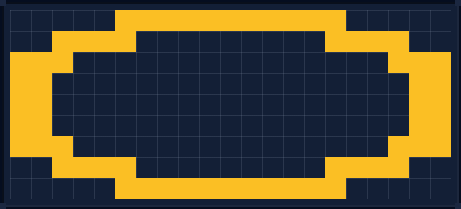
An outline blueprint is a one-block ring with an empty middle: the right start for a pond, fountain, window frame, arena border, or courtyard wall. A filled blueprint includes every inside cell, which suits a floor, table top, or solid slab.
For a one-block ring, the nominal clear box is width - 2 by height - 2: 21×9 gives 19×7, and 31×15 gives 29×13. Treat that as a maximum, not a guarantee. The stepped curve cuts the corners and can pinch the space near the ends, so check the actual rows. A second inner ring gives a two-block wall and shrinks the clear box to 17×5 and 27×11.
A thin ring is cheap but weak at a distance. If the oval is a pond edge, a raised rim, or a wall seen across a courtyard, plan a second course or a row of slabs before you lay the first ring.
What Each Oval Size Is Good For
- 15×7: window or fountain. A 42-block 15×7 oval outline fits a wall bay or small basin. The 69-block filled version takes two stacks.
- 21×9: pond or table. The 21×9 oval is wide enough for a garden pond or a long table top. Its 62-block ring is quick to place; the 133-block fill takes three stacks.
- 31×15: arena or courtyard. A 31×15 oval gives a fenced arena floor or a courtyard border with room for a center feature. The outline is 90 blocks; a filled floor is 337 blocks, or six stacks.
- 41×21: plaza or large pool. The 41×21 oval suits a spawn plaza, a formal pool, or a market ring. Expect 122 blocks for the outline and 641 for the fill, about eleven stacks.
An oval earns its place when a circle would leave too much empty space. A circle occupies a square footprint; an oval can stretch to a long wall or rectangular lawn while keeping a curved edge. The circle guide covers the one-axis pattern, the circle size chart helps match a width to a room, and the sphere guide covers round 3D forms.
Fixing a Lopsided Oval
- Wrong center. If one end looks longer, recount from the center, not from the opposite edge.
- Width and height swapped. A 21×9 oval is wide and shallow; 9×21 is tall and narrow. Say the pair width first and check the blueprint orientation before placing blocks.
- Filled before checking symmetry. A solid middle hides the center line. Finish and inspect the ring, then fill.
- Even dimensions in an odd build. An odd oval has a single center block that lines up with odd-width doors, paths, and rooms. If the surrounding build is odd, keep both oval dimensions odd.
- A ring that is too thin. One block suits a garden border; a fountain wall or window frame may need a second course. Thicken inward so the outside dimensions stay correct.
FAQ
Is a Minecraft oval the same as an ellipse?
Not exactly. In math, an ellipse is a precise curve defined by two axes and two focal points. A Minecraft oval approximates that proportion on a grid: the square cells decide the edge, so it moves in steps. At build scale it reads as an oval, but it is not a mathematically exact ellipse. CircleGen calls the shape an oval and shows the block pattern for each indexed pair.
What size oval should I build?
Start with the footprint. Match the width to the long horizontal space and the height to the short vertical space. A 15×7 oval suits a window or fountain rim, 21×9 a pond or table, 31×15 an arena or courtyard, and 41×21 a plaza or large pool. If a circle would leave wide empty corners, a flatter oval fills the area better.
Can I make a hollow oval?
Yes. The outline blueprint is already a hollow one-block ring, so leave the middle empty and add a floor, water, or grass. For a one-block wall, the nominal clear box is width minus 2 by height minus 2, but the stepped ends can pinch it. Check the actual rows before promising a full rectangle. Add a second inner ring for thicker walls.